
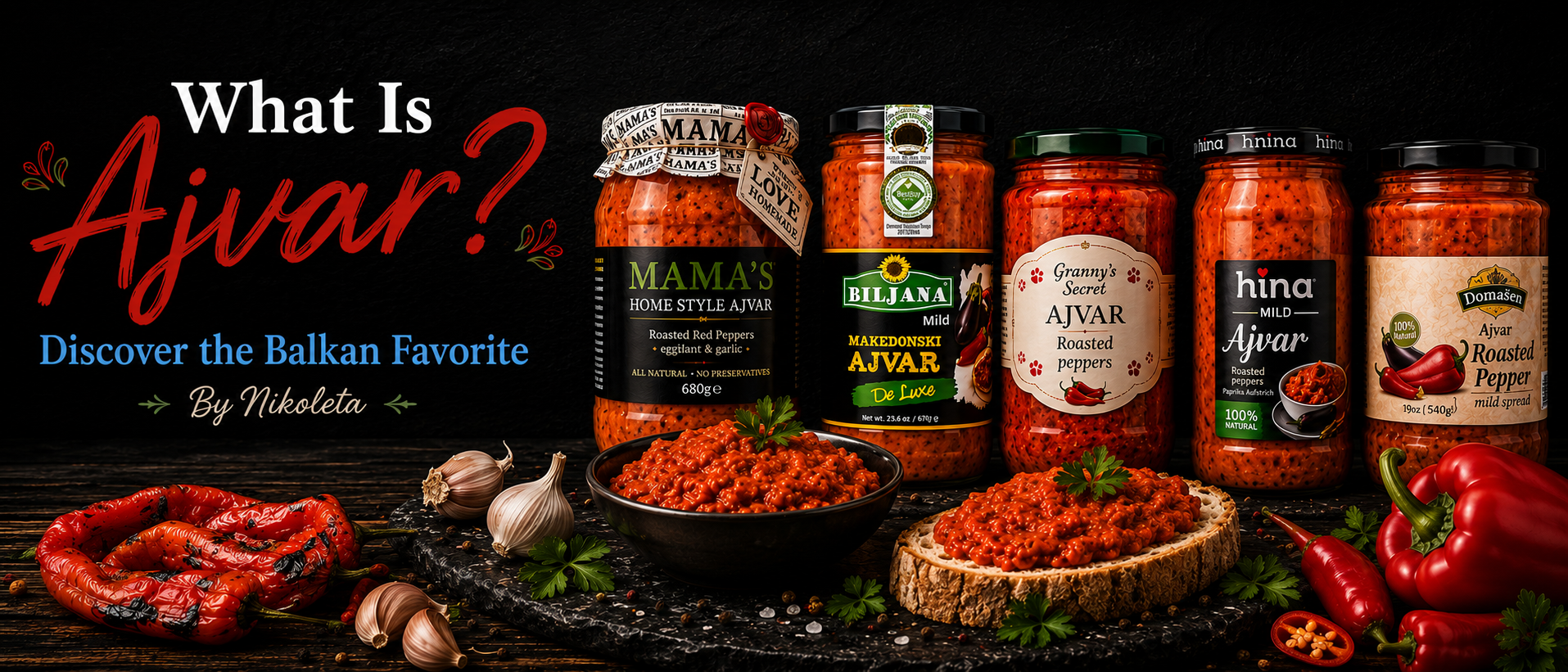
What is Ajvar?
Growing up in Cleveland, Ohio, my autumns never smelled like pumpkin spice. For my family, and especially for my mother who emigrated from Arilje, Serbia, September meant one thing: the smoky, sweet, and unmistakable aroma of roasting red peppers.
As a first-generation Serbian-American, a mother of three, and someone who spends my days navigating the world of business IT, I find that my kitchen is where I truly reconnect with my roots. Today, I want to share the story of a condiment that is more than just a spread - it is our "red gold." I’m talking about Ajvar, the legendary "Red Pepper Caviar" of the Balkans.
What is Ajvar, really?
If you’ve never had the pleasure, Ajvar (pronounced eye-var) is a rich, savory spread made primarily from roasted sweet red bell peppers and often roasted eggplant. It has a silky, creamy consistency that can range from completely smooth to pleasantly chunky, depending on who is standing at the stove.
The name itself carries a fascinating history. It comes from the Turkish word havyar, which means "salted roe" or "caviar". Back in the late 19th century, Belgrade was actually a hub for real caviar production because sturgeon would swim up the Danube from the Black Sea. However, labor disputes in the 1890s made caviar production unsteady. Enterprising local restaurants began serving a special red pepper salad as a substitute, calling it "red ajvar" or "Serbian ajvar". The name stuck, and while there’s no fish roe in our modern jars, the "Balkan Caviar" moniker remains a tribute to its luxury and the intense labor required to make it.
The heart of the Balkans - Where does it come from?
While Serbia is the traditional home of Ajvar, it became a staple throughout the region - North Macedonia, Croatia, Bosnia and Herzegovina, and Bulgaria - largely after World War II when the area was united as Yugoslavia. Every family and every nation claims to have the "authentic" version.
In my house, we stick to the Serbian roots, but I’ve learned to appreciate the nuances, like the Macedonian preference for omitting garlic or the Slovenian addition of more eggplant for creaminess.
Sezona Ajvara - The traditional craft
In the Balkans, late summer and early autumn are known as sezona ajvara (the Ajvar season). It isn't just a cooking task; it's a cultural event where neighbors and entire families gather to process hundreds of pounds of peppers.
The process starts with the right pepper. We look for "Roga" (horn-shaped) or "Kurtova Kapija" peppers - large, red, fleshy, and flat, which makes them easier to roast. To give you an idea of the concentration of flavor, it takes roughly four kilograms of peppers to produce just one kilogram of high-quality Ajvar.
The traditional method is a labor of love:
- Roasting - the peppers are charred over open wood fires or special stoves until the skins are blackened. This imparts a deep, complex smokiness that you just can't replicate in a standard oven
- Steaming and peeling - once charred, the peppers are steamed in bags to loosen the skins. Then comes the manual labor - carefully peeling the burnt skins and removing every seed by hand
- Draining - this is a step many modern recipes skip, but it's vital. The peeled peppers are hung in mesh bags or placed in colanders overnight to drain excess liquid. The drier the peppers, the more concentrated the final spread
- Simmering - the peppers (and often roasted eggplant) are ground and then simmered "low and slow" in sunflower oil and salt for hours. We say it’s ready when the mixture is thick enough to hold its shape on a spoon and the oil begins to separate
How to bring Ajvar into your modern life
As a busy mom, I don’t always have two days to roast 100 pounds of peppers, but I always keep a jar in my pantry. It is incredibly versatile and - bonus for my health-conscious friends - it’s naturally vegan, gluten-free, and packed with Vitamin C. In fact, a single 25g serving can provide a significant portion of your daily Vitamin C needs.
Here is how we use it in our home:
- The classic way: Slathered generously on crusty rustic bread, often paired with a salty white cheese like feta
- With grilled meats: It is the essential companion to ćevapi (Balkan grilled sausages) and pljeskavica
- A modern breakfast: Stirred into scrambled eggs or served alongside fried bread and olives for a hearty mountain-style breakfast
- Pasta and pizza: Believe it or not, it makes a fantastic, flavorful alternative to tomato sauce for pasta or as a base for a gourmet pizza
- Entertaining: It’s a bright, colorful addition to any charcuterie board or as a dip for fresh vegetables and crackers
Bringing the tradition home
For those of us in the States, recreating that village fire-roasted taste can be tough. While nothing beats my mother’s homemade jars, there are some incredible authentic brands that use traditional methods. If you want to experience the real deal without the "smoky mess" in your own kitchen, I highly recommend checking out the selection at PV Euro Market.
You can find high-quality options like the Podravka Ajvar Mild Roasted Red Pepper Spread 690g, which is a staple in many Balkan households, or for those who like a bit of a kick, the Mamas Hot Ajvar Roasted Pepper Spread 550g captures that home-cooked intensity.
If you are looking for a variety that highlights the silky texture of added eggplant, the VaVa Homemade Mild Ajvar Roasted Red Pepper Spread 680g is an excellent choice.
For a truly premium experience that reminds me of the jars we used to bring back from Serbia, Grannys Secret Mild Ajvar Roasted Red Pepper Spread 550g is hard to beat.
Preserving our heritage
As I teach my children how to say "prijatno" (bon appétit) and explain why we wait all year for the "pepper season," I realize that Ajvar is more than a condiment. It’s a link to a place and a people. It’s the taste of my grandmother’s kitchen in Arilje, preserved in a jar and shared in Cleveland.
Whether you’re a fellow Balkan expat looking for a taste of home or a foodie looking to expand your palate, I invite you to try a spoonful of Ajvar. It’s sweet, smoky, and carries the warmth of centuries of tradition.
Prijatno!
I hope you enjoyed the post! As someone who balances a busy career in IT with the beautiful chaos of raising three kids, I know that once you discover Ajvar, you start seeing a dozen ways to use it every day. To help you share this "red gold" with your own family and friends, here are seven of the most common questions I get asked about our favorite Balkan spread.
FAQ:
1. Does traditional Ajvar always contain eggplant?
Not always! While my family loves the "silky, smooth creaminess" that roasted eggplant adds, there is a friendly debate across the Balkans about this. Some purists insist that true Ajvar should only be made with roasted red peppers, oil, and salt. You might even find regional variations like North Macedonian recipes that omit garlic, which is a staple in Serbian versions.
2. Why is it famously called "Balkan Caviar"?
It’s a bit of a historical tribute! The name "Ajvar" actually comes from the Turkish word havyar, which means "salted roe" or caviar. In the late 19th century, Belgrade was a major producer of real sturgeon caviar from the Danube. When labor disputes made fish roe hard to find in the 1890s, local restaurants started serving this precious red pepper spread as a luxurious substitute, eventually calling it "red ajvar" or "Serbian ajvar".
3. Is Ajvar suitable for people with dietary restrictions?
One of the reasons I love serving Ajvar to my friends here in Cleveland is that it’s incredibly inclusive. It is naturally vegan, gluten-free, and low in calories. It’s also a nutritional powerhouse for the winter months; just one 25g serving can provide roughly 43% of your daily Vitamin C requirement.
4. How long will a jar last once I've opened it?
If your family doesn't finish the jar in one sitting (which happens often at our house!), it will typically stay fresh in the refrigerator for several weeks to a month. A traditional tip to keep it fresh longer is to press a thin layer of oil over the surface of the spread to create a natural seal before putting the lid back on.
5. I’m not grilling meat today - how else can I use it?
Ajvar is the ultimate "modern mom" kitchen hack! Beyond serving it with traditional ćevapi, it is a fantastic shortcut for pasta sauce, a savory base for gourmet pizzas, or a flavor boost stirred into scrambled eggs. It’s also perfect for hosting; I love adding it to charcuterie boards as a dip for fresh veggies or crackers.
6. Can I make Ajvar without eggplant if my family prefers a simpler taste?
Yes! While I love the silkiness eggplant adds, many traditionalists prefer using only roasted red peppers, oil, and salt. Without eggplant, the spread is brighter and more pepper-forward but just as satisfying.
7. What is the secret to getting the right consistency at home?
The secret is in the peppers and the prep! We traditionally use fleshy "Roga" or "Kurtova Kapija" peppers, which are easier to peel after roasting. Crucially, you must drain the roasted vegetables thoroughly - often overnight - to remove excess liquid before you begin the "low and slow" simmering. This patience ensures the Ajvar is thick enough to hold its shape on a spoon.